

Adorno-Cycle I
Prologue

What we love
Acrylic on canvas
60x60 cm
2025
What we do
Acrylic on canvas
60x60 cm
2025

What we get
Acrylic on canvas
60x60 cm
2025
Diptych: Beauty

All Inclusive
Appropriation: The Birth of Venus (Botticelli)
Oil on canvas
140 x 120 cm
2026
Botticelli’s Venus stands in a rusty oil drum against a tropical beach backdrop. A turquoise sea, palm trees and a picture-postcard sky promise a holiday idyll, yet the foreground is littered
with plastic waste. Venus, the symbol of beauty and birth, becomes an icon in an oil bath – half goddess, half victim of our fossil-fuel-dependent lifestyle. The title “All Inclusive” turns the
language of the tourism industry against itself: the price also includes oil, rubbish and destroyed beaches. Picturesque seduction and ecological indictment intertwine; the image shows just how
much we cling to the dream of paradise, even though its material foundations have long since been poisoned.
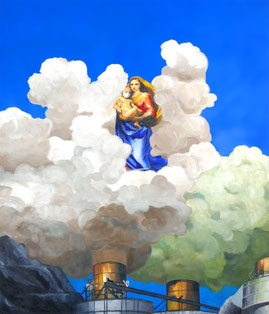
Insence
Appropriation: The Sistine Madonna (Raphael)
Oil on canvas
140 x 120 cm
2026
The Sistine Madonna with the Infant Jesus floats in magnificent robes amidst grey-brown clouds – yet the clouds rise from the chimneys of a power station. The title “Insence” alludes to incense and “insane”: our contemporary “incense offerings” consist of exhaust fumes and emissions. The sacred figure appears as an image of consolation emerging precisely from the destructive conditions of production from which it is meant to protect. The work thus questions religion, ideology and consumerist promises in equal measure, and shows how images of salvation become the cosmetic veneer of a fossil-fuel-driven world.

Triptych: Drought

Let me!
Appropriation:The Sower
(Vincent Van Gogh)
Oil on canvas
140 x 120 cm
2025/26
Van Gogh’s Sower strides across a parched field, yet above him a fiery sky blazes; the canvas is burnt and torn open in several places. Red and black ‘wounds’ gnaw
their way into the mountains and the sky, as if the world were already charred. “Let me!” sounds like a final plea: to sow once more, as if there were a future. The painting confronts the classic
symbol of hope and connection to nature with a landscape whose conditions have been irrevocably destroyed. Pictorial energy and the actual damage to the canvas intertwine to form a powerful
metaphor for the futility of individual effort in the face of climate catastrophe.
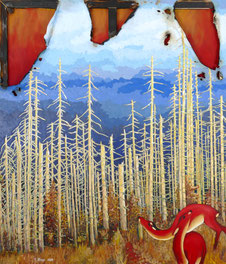
The German Forest
Appropriation:The Red Deer
(Franz Marc)
Oil on canvas
140 x 160 cm
2025/26
Two red deer, in the style of Franz Marc, stand in a forest that consists now only of pale, skeletal tree trunks. The ground appears dry, the vegetation sparse; in
the background, blue hills rise in terraces. The time-honoured myth of the ‘German forest’ appears here as a hollowed-out shell. Marc’s animals, once a symbol of a utopian unity between animal
and nature, have become mere vestiges, without shelter or cover. The vivid colours of the deer clash with the desolation of their surroundings. The image shows how a culturally idealised view of
nature is shifting in the age of the climate crisis – from a place of longing to a testament to structural destruction.
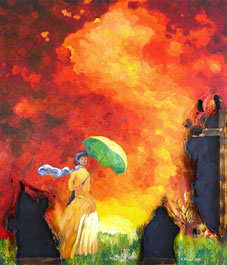
See - it works !
Appropriation: The Woman Walking
(Claude Monet)
Oil on canvas
140 x 120 cm
2025/26
A woman walking with a parasol, painted by Monet, stands before a wall of fiery colours. The canvas is charred, with black underlayers breaking through. The
parasol, a symbol of bourgeois gestures of protection, seems absurd against the backdrop of the burning surroundings. “See – it works!” reads like a cynical commentary on technocratic
reassurances: The only thing that “works” is the catastrophe itself. The painting transforms the Impressionist idyll into a stage of repression. The painterly beauty remains, but it conceals an
existential threat – and thus reveals just how much our own protective rituals are part of the problem.
Triptych: Floods
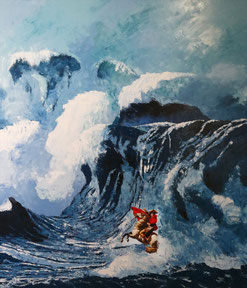
All According to Plan
Appropriation:Napoleon
Crossing the Alps (J.L. David)
Oil on canvas,
140 x 120 cm
2026
The central figure is taken from Jacques-Louis David’s famous painting *Napoleon
Crossing the Alps*, in which the victorious
commander, mounted on a rearing horse,
heroically conquers the mountain pass. In this version, however, Napoleon does not ride through rugged high mountains, but straight into a towering wall of water. The pose remains the same: an
upright posture, a red cloak, the air of unshakeable control. Yet the setting has changed radically – the triumphant crossing of the Alps has become a ride into climate catastrophe.
The title “All According to Plan” reveals a biting irony. It sounds like the
reassuring mantra of political and eco-
nomic decision-makers who, even
in the face of escalating crises, claim that
everything is going according to plan. The appropriation of the Napoleonic image of power translates this pathos into the present: the historical myth of the sovereign, nature-conquering leader
becomes image of a power that refuses to acknowledge its own powerlessness. Between David’s heroic icon and the crashing wave, a gap emerges, revealing that it is precisely this form of
‘planning’ and belief in progress that has led to catastrophe – and yet persists.
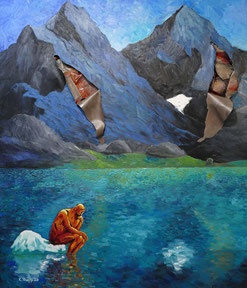
Don't Worry - He's Thinking
Appropriation: The Thinker
(Auguste Rodin)
Oil on canvas, with two cut-outs mounted behind.
140 x 120 cm 2025/26
The iconic Thinker no longer sits on
his secure stone pedestal, but on
the last melting ice floe in the middle of
a mountain lake. Whilst the water’s surface shimmers in cool shades of blue and turquoise, the figure’s body glows an unnatural orange – as if thought itself were overheating. The alpine
backdrop, traditionally a canvas for grandeur and untouched nature, is showing cracks: slashed mountain flanks reveal collaged layers reminiscent of meat’s innards. Here, the landscape appears as
wounded skin and, at the same time, as a thin surface.
The sarcastic title “Don’t Worry, He’s
Thinking” comments on the inaction
in the face of ecological disaster.
Thinking that is self-sufficient becomes a
gesture of reassurance: one “ponders”
the situation, whilst ice, mountains and
bodies are already in the process of disintegrating. The work intertwines artistic reference, the climate crisis and visual critique: it depicts a world in which the
grand gestures of contemplation come too late – and in which nature is now merely
the thin, fragile surface of an overheated system.
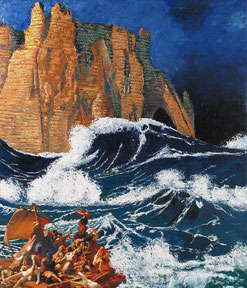
75 Meters later
Appropriation:The Raft of the Medusa
Frédéric Géricault) and The Cliffs of Étretat (Édouard Manet)
Oil on canvas,
140 x 120 cm 2026
The title “75 Metres Later” refers to
a specific climate forecast: if the
ice at the South Pole melts completely, the
global sea level will rise by around 75 metres – enough to flood even the iconic cliffs of
Étretat. In this image, two art-historical appropriations converge: the luminous rock formation recalls Monet’s views of Étretat, in
which the sea becomes a place of light, of the atmosphere and painterly experimentation.
At the same time, in the foreground,
the raft from Géricault’s ‘The Raft of the
Medusa’ pushes its way into the picture –
a symbol of collective shipwreck, state indifference and the raw struggle for survival.
A tension arises between Monet and Géricault: the romantic, impressionist coastal idyll is disrupted by an overwhelming wave and a
crowded raft that does not fit into the picturesque setting. The sublimity of nature turns into a threat, and the historical catastrophe is extended into our present – at a time when man-made
climate change
is driving millions of people into the water.
“75 Metres Later” presents Étretat as a
fragment of the future: a place still visible,
but already under negotiation, where
art history, the image of tourism and real
catastrophe collide in a single stormy wave.
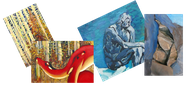
Diptychon Ignoranz
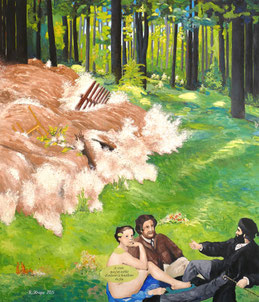
No Way - Not Us!
Appropriation: Breakfast on the Grass (Eduard Manet)
Oil on canvas,
Thought bubbles added,
140 x 120 cm
2025
Manet’s picnic party sits in a sun-drenched wood, engrossed in a mundane conversation that appears as a thought bubble. Behind them, a massive torrent of water and mud is tearing through the forest, sweeping away chairs, fences and plants. The figures show no reaction; the phrase “No way – not us!” sums up their attitude. The image illustrates the gulf between the bourgeois comfort zone and real-world threat. At the same time, the thought bubbles undermine any remaining ‘high art’ pathos: the post-autonomist, decorative appropriation is stripped bare by everyday language. Climate catastrophe and the art world appear as two levels of the same mechanism of repression.

Caribbean Dreams
Appropriation: Are you jealous?
(Paul Gauguin)
Oil on canvas, speech bubbles
mounted
140 x 120 cm
2025
Gauguin’s island women rest in a tropical landscape, whilst behind them a murky liquid pours into the river from a large pipe. The colours remain alluring, the poses relaxed, yet the
intrusion is impossible to overlook. Speech bubbles in Creole circle around mundane questions and undermine any heroic or exoticising interpretation. “Caribbean Dreams” reflects tourist and
colonial projections: the dream of the unspoilt South Seas stands in contrast to an environment that is already severely polluted. The image shows how images of paradise and simplicity continue
to circulate, even though the regions they depict are among the hardest hit by the global crisis.

Epilogue
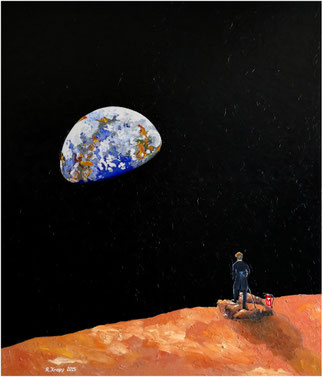
That's it !
Appropriation: The Wanderer Above the Sea of Clouds
(Caspar David Friedrich)
Oil on canvas
140 x 120 cm
2025
Caspar David Friedrich’s Wanderer stands on a reddish rock, yet instead of gazing out over a sea of mist, he looks out into space. Before him hovers a wounded planet, still recognisable as Earth, but scarred by zones of fire and devastation. The rest of the picture is deep black. At his feet stands a small red fire extinguisher – helpless in the face of the cosmic scale of the crisis. “That’s it!” feels like a bitter conclusion: no romantic retreat into nature, no technical solution, only the belated realisation of the extent of the destruction. The image concludes the cycle with a concentrated, laconic diagnosis of powerlessness and the end.