

Adorno Cycle II
The second cycle explores the question of what drives humanity to destroy the very foundations of its own existence. The cycle is currently in progress – here are the first pieces.
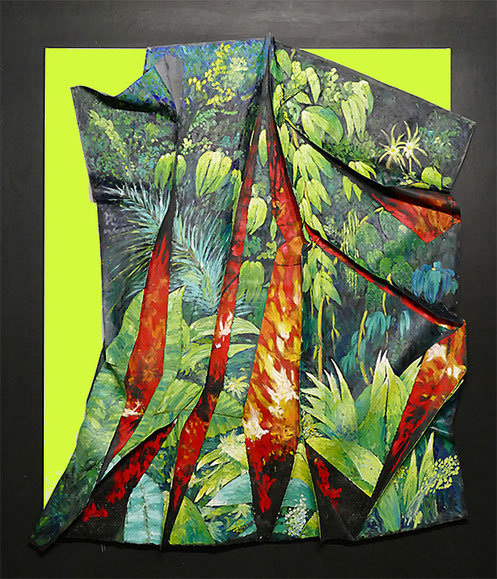
Painforest
Oil on stretched and unstretched canvas,
mounted on a light green backing
150 x 135 cm
2026
“Painforest” portrays the rainforest as a body burning from within. The bright red swathes are not external traces of slash-and-burn farming, but resemble exposed veins through which fire
circulates instead of blood. The folds in the canvas open up fissures and cracks through which this inner embers push their way to the surface – the canvas itself seems to be warping under its
own pain.
At the same time, the lush greenery projects a deceptive vitality: the forest still appears dense and alive, yet the destructive energy is already inscribed within it.
“Painforest” thus links ecological threat with a psychological image: the damaged planet appears as an organism that can no longer conceal its wounds. The painting reveals that the catastrophe
does not come from outside, but from within us: from a desire for ever-increasing meat consumption and, consequently, ever-expanding pastureland. Here, the rainforest burns not only in the image,
but as a mirror for a civilisation that is setting itself alight.
Diptych: Hunger

Mure Nostrum
Appropriation: Sertigpfad in Summer (Ernst Ludwig Kirchner)
Oil on canvas,
a cut-out, with the back hanging out and painted in acrylic.
150 x 100 cm
2026
In a mountain landscape by Kirchner, a grey mudslide rolls through the valley. A large section of the canvas is left uncovered, revealing the black stretcher frame; beneath it appears a second painting featuring a chimney and smoke – the hidden energy infrastructure. ‘Mure Nostrum’ makes cause and effect visible: above, the expressionist high-mountain landscape; below, the industrial processes that bring about the catastrophe. The black area represents the blind spot between the two planes. The work combines landscape painting, the nature of the object and political visual thinking into a precise allegory of a shared, home-grown destruction.

Last Rites
Appropriation: Improvisation (Wassili Kandinsky)
Oil on canvas, a cut-out, with the back hanging out and painted in acrylic.
130 x 100 cm 2026
The upper surface evokes Kandinsky’s abstract perception of colour as a vibrant, multifaceted landscape of lines and planes. A large cut-out reveals the black backing; beneath it hangs a second image: a strictly uniform grid of palm oil plants. “Last Rites” stages the transformation of biological and aesthetic diversity into industrial monoculture. What began as a free play of colours is swallowed up by the logic of the plantation. The title alludes to a final act at the deathbed – here for both the ecosystem and autonomous art. The work combines ecological critique and art-historical reflection in a single material gesture.